by
Athanasius(From my own blog Athanasius Contra Mundum. This started my work on Distributism on the net)

For many years I have been a Free Market Capitalist. There are a number of reasons for this, one of which is that it is just the conservative thing to do. One thing that unites the majority of conservatives both neo-cons like Sean Hannity and Bill Krystol as well as paleo-conservatives such as Thomas Woods and Pat Buchanan is capitalism and free market economic principles, or at least that mantle even if they read it slightly differently. Free market Capitalism basically means that if you keep markets unregulated in all arenas, business will keep itself well regulated and allow sufficient competition, so that a man with ingenuity and hard work can rise to the top and be a millionaire. How? By using capital at his disposal or in reality someone else's capital, and getting a bunch of wage slaves to produce it into goods for him while he works to manage it, until he either succeeds or fails. This happens on either a large scale or on a small scale. For years this made sense, but since the summer, I have finally called all of this into question, and at last have completely rejected it as a defective produce of the modern era, just as defective as ideas like unrestricted freedom of speech, relativistic morality and democracy. For one the business world working on the free market model has shown itself time and time again unwilling to discipline itself, and more interested in satisfying the bottom line. When the wage of the employee who is going to create wealth he will never see becomes too high, the company will either cut the position, cut the pay, or take its business over seas where it can exploit labor. The illegal immigration problem clearly demonstrates this. My number 2 problem with illegal immigration (after number 1 which is the flow of gangs, criminals and drugs uncontested across the border) is that people coming here to work hard for their family will be exploited by big business and have no legal protection.
I could go on, but rather than complain, it is necessary to show a vision for the future, and to do that it is necessary to point to one thing: Capitalism isn't it. In fact, growing up in America, we are conditioned to think Capitalism good, Communism bad, anything else bad. Outside the box there is no salvation. Suddenly the reader is no doubt pausing in horror, Athanasius, you are not becoming a Communist, are you? You're Communism series hasn't converted you has it? Certainly not. But if you say you are against Capitalism, the first thing that comes to mind is that you must be a Socialist or a Communist. However I feel it necessary to point out at this juncture that just as Communism is an anti-God and anti-Religious philosophy and economic science, Capitalism is equally against Catholic principles and the moral authority of Church teaching.

Captialism represents every man for himself alone, the successful man is the one with the most cash philosophy. However measuring one's success in terms of wealth is directly related not to Catholicism, as such a system would seem grossly wicked to 1531 years of Catholics, but with Calvinism. Capitalism truly has its roots in the Protestant Reformation, both directly and indirectly. Indirectly, as Luther and Calvin had no intention of willing the oppression and suffering that occurred with Capitalism, and directly, as their attacks on a system that protected men's livelihood and kept capital concentrated in the hands of the many rather than the few. Luther of course had no economic vision whatsoever. His ideas concerning economics were still quite Catholic in spite of everything else. Calvinism on the other hand began measuring whether or not one was saved based on economic success, since that salvation was predetermined by God and as such unknowable. In the hands of classical economists, one bettered society by making as much money as he could, regardless of the human cost, and thus we arrive at the Free Market Economy. (This would also mean that the reformation is indirectly responsible for socialism, since it created the problem to which Socialism is the proposed solution and would not exist otherwise.

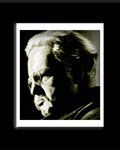
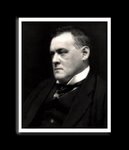
On the other hand there is the Catholic vision for economics, man's livelihood and the social kingship of Jesus Christ. It is not a terribly new system, as it was in practice from the period of the late Roman Empire until by and large after the Protestant and French Revolutions. It is a system which in modern times is called "Distributism", an exposition of Catholic social teaching most identified with Hillaire Belloc and G.K. Chesterton, who formally introduced it in the early 1900's.
As I said Distributism is nothing new, but a predication of Medieval economic theory and practice. Some critics falsely maintain that it is the same as Socialism, but anyone who makes this objection only shows they do not know what they are talking about. Socialism is predicated on the denial of the right to private property, especially private productive property, whereas Distributism is predicated on the affirmation of the right to private productive property.
Hence the Late Romano-Medieval system, the right of a man to property by which he might take capital and produce it into goods for sale or consumption was paramount, far above the right to make money. This is because a Catholicized society did not see life as the necessity to amass wealth, but as a period to accomplish the salvation of our soul. This focus on the spiritual ends brings about a natural frugality with resources, money, and a modesty in the way one spends his time and engages in worldly goods. Belloc said
"It has been found in practice (that is, it is discoverable through history) that economic freedom thus somewhat limited satisfies the nature of man, and at the basis of it is the control of the means of production by the family unit. For though the family exchange its surplus, or even all its production, for the surplus of others, yet it retains its freedom, so long as the social structure, made up of families similarly free, exercises its effect through customs and laws consonant to its spirit: the Guild; a jealous watch against, and destruction of, monopoly; the safeguarding of inheritance, especially the inheritance of small patrimonies. The freehold miller, in such a society as ours [English] was ours not so long ago, though he had no arable or pasture, was a free man. The yeoman, though he got his flour from the miller, was a free man." -An Essay on the Restoration of Property, pg. 27)
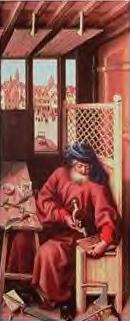
To elaborate on guilds, some falsely maintain that a guild is essentially like our modern notion of a Union. A Union, is essentially a gathering of bureaucrats who live like leeches on the dues of its members under the promise of improving working conditions, a promise delivered 100 years ago, but not even thought about now since the bureaucrats who control unions have gotten a taste of the cash and fine living that comes with being a union president. A Guild never functioned that way. Guilds were a body of craftsmen in a given disciplines such as those of blacksmith, carpenter, cobbler, butcher, etc. Their purpose was to improve craftsmanship on the part of their members and to make sure that they were operating fairly. Dishonest workers would be thrown out of the guild and as such lose business due to a bad reputation. Guilds were inherently Catholic bodies, with their patron saints, celebrations, banners to process into Mass with, and protection from the Church. Its members and leaders were all craftsmen themselves employed in a given trade, not bureaucrats looking to spend the hard earned money of its workers for political gain. Always they defended the livelihood of the worker. Stealing the means by which a man feeds his family through monopolizing was no different than stealing the food itself from his children.
This brings us to the essence of distributism, that which the Guilds labored hard to defend. The name sounds funny, because we are unaccustomed to it. Distributism has nothing to do with government re-distribution, it merely refers to the fact of private productive property being well distributed (or diffused) amongst the people. Belloc notes:

"When so great a number of families in the state possess Private Property in a sufficient amount as to give its color to the whole, we speak of "widely distributed property. It has been found in practice, and the truth is witnessed to by the instincts in all of us, that such widely distributed property as a condition of Freedom is necessary to the normal satisfaction of human nature. In its absence general culture ultimately fails and so certainly does citizenship." -Ibid, pg. 28
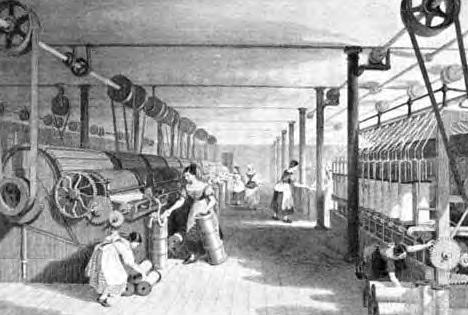
Capitalism is also a slightly misleading word. Its name would suggest that it is just a system about the amassing of capital and the production of capital into wealth. However, this would accurately describe every economic arrangement human society has known, including Communism. Capitalism then (as practiced since it was forged by the big three revolutions of Protestantism, the Industrial Revolution and the French Revolution) is understood as a system where a minority controls the means of production, and the majority of the dispossessed must sell their labor, because that is all that they have left. The dispossessed are referred to as the "Proletariat" a term used today mostly by Marxists, which predates Marx by half a century. This accurately describes the situation in most of the world today. The alternative that Distributism offers is freedom. Instead of being required to sell our labor for a wage (wage slavery) in order to survive, we ourselves become the producers, consumers, on our own land on our own time. As wage slaves we must be present 9-5, or else risk the wrath of our employer. How many people would trade that to be self-sufficient? Come on, on one side you have life in a little cubicle, no windows, 3 bosses who harass you all day, and the best hours of your life spent not with your spouse and children but with your fat, balding boss, while on the other hand you have life on your terms, so long as you are willing to work hard. Which system seems more conducive to holiness? Distributism is the economics of the middle ages, and it is the only system that represents freedom. Anything else is a godless son of either protestantism or the enlightenment.






men put with such ease into possession of the new methods? Why was it normal and natural in their eyes and in that of contemporary society that those who produced the new wealth with the new machinery should be proletarian and dispossessed? Simply because the England upon which the new discoveries had come was already an England owned as to its soil and accumulations of wealth by a small minority: it was already an England in which perhaps half of the whole population was proletarian, and a medium for exploitation ready to hand.
orted him and confirmed him in his property had been broken to pieces by no "economic development," but by the deliberate action of the rich. He was ignorant because his schools had been taken from him and the universities closed to him. He was the more ignorant because the common life which once nourished his social sense and the cooperative arrangements which had once been his defense had disappeared. When you sought an accumulation of corn, of clothing, of housing, of fuel as the indispensable preliminary to the launching of your new industry; when you looked round for someone who could find the accumulated wealth necessary for these considerable experiments, you had to turn to the class which had already monopolized the bulk of the means of production in England. The rich men alone could furnish you with those supplies.